## Highlights
### Agents and orchestration
- 🤖 **Agentic execution** translates natural-language intent into governed, auditable security actions.
- 🧩 **Eino orchestration** supports single-agent execution plus Deep, Plan-Execute, and Supervisor multi-agent modes.
- 🔀 **Graph workflows** combine Agents, tools, conditions, approvals, and outputs into reusable flows.
- 🎭 **Role-based testing** provides focused prompts and tool policies for common security scenarios.
### Tools and knowledge
- 🧰 **Security tools** include 100+ curated YAML recipes with custom extensions and role-scoped access.
- 🔌 **MCP integration** supports HTTP, stdio, SSE, external federation, and dynamic tool discovery.
- 🎯 **Agent Skills** follow the standard Skill layout and support progressive, on-demand loading.
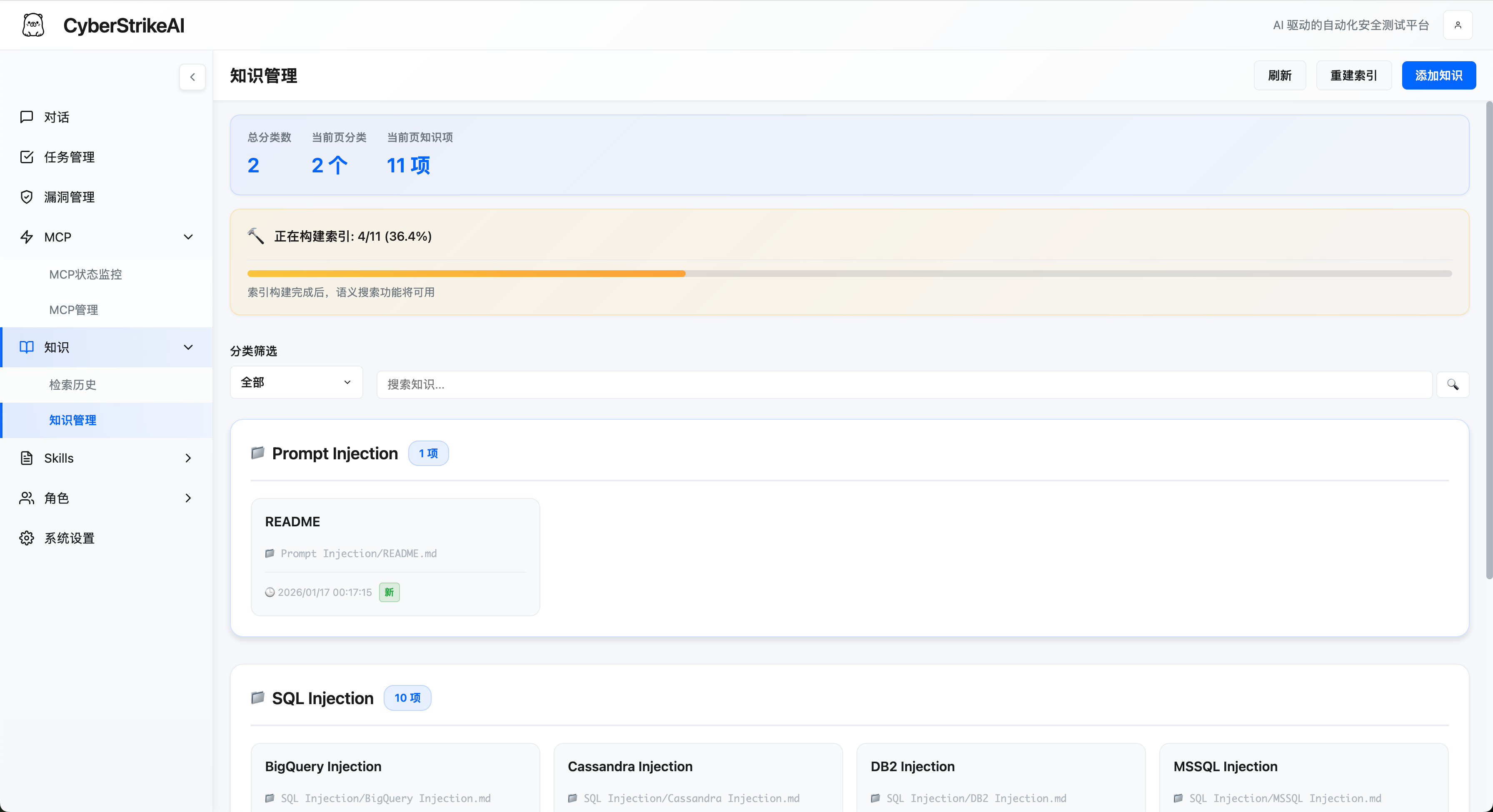
- 📚 **Knowledge base** combines query rewriting, vector retrieval, reranking, and result post-processing.
- 🖼️ **Vision analysis** uses a separate vision model for screenshots, captchas, and UI while retaining text summaries only.
### Governance and audit
- 🧑⚖️ **Human in the loop** provides approval modes, tool allowlists, audit-agent review, and traceable decisions.
- 🔐 **Platform RBAC** supports multiple users, system and custom roles, scoped permissions, ownership, and explicit assignments.
- 🔒 **Security and audit** provide authenticated access, audit logs, SQLite persistence, and operational evidence retention.
- 📄 **Result governance** supports pagination, compression, archival, and search for large tool outputs.
### Security operations
- 📁 **Conversation management** provides grouping, pinning, renaming, and batch organization.
- 📂 **Projects and attack chains** connect cross-session facts, risk scoring, graph views, and step-by-step replay.
- 🛡️ **Vulnerability management** provides severity classification, lifecycle tracking, filtering, and statistics.
- 📋 **Batch tasks** provide queued execution, editing, status tracking, and retained results.
- 📱 **Chatbots** connect Personal WeChat, WeCom, DingTalk, Lark, Telegram, Slack, Discord, and QQ Bot.
### Authorized security operations
- 🐚 **WebShell management** provides connection management, a virtual terminal, file operations, and AI-assisted workflows.
- 📡 **Built-in C2** provides listeners, encrypted beacons, sessions, task queues, payload helpers, and live events.
> WebShell, C2, and other high-risk capabilities are for systems you own or are explicitly authorized to test. See the [security model](docs/en-US/security-model.md) and [hardening guide](docs/en-US/security-hardening.md).
## Plugins
CyberStrikeAI includes optional integrations under `plugins/`.
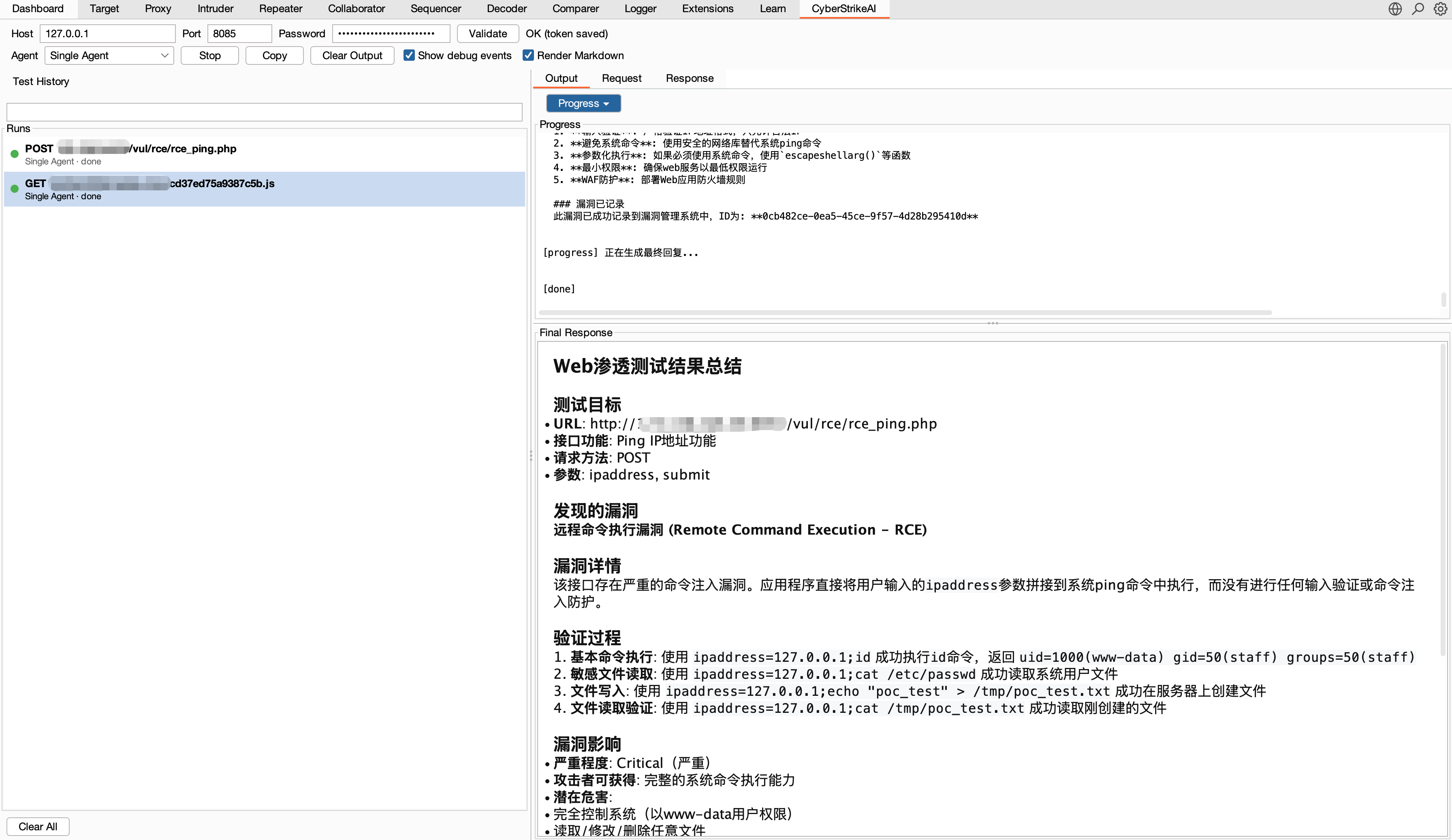
- **Burp Suite extension**: `plugins/burp-suite/cyberstrikeai-burp-extension/`
Build output: `plugins/burp-suite/cyberstrikeai-burp-extension/dist/cyberstrikeai-burp-extension.jar`
Docs: `plugins/burp-suite/cyberstrikeai-burp-extension/README.md`
- **Browser extension (Chrome / Edge)**: `plugins/browser-extension/cyberstrikeai-browser-extension/`
Capture Network traffic in DevTools and send it to CyberStrikeAI for AI-assisted security testing—aligned with the Burp plugin.
Install: `chrome://extensions/` → Load unpacked → F12 → **CyberStrikeAI** tab
Package output: `plugins/browser-extension/cyberstrikeai-browser-extension/dist/cyberstrikeai-browser-extension.zip`
Docs: `plugins/browser-extension/cyberstrikeai-browser-extension/README.md` / `README.zh-CN.md`
## Tool Overview
CyberStrikeAI ships with 100+ curated tools covering the whole kill chain:
- **Network Scanners** – nmap, masscan, rustscan, arp-scan, nbtscan
- **Web & App Scanners** – sqlmap, nikto, dirb, gobuster, feroxbuster, ffuf, httpx
- **Vulnerability Scanners** – nuclei, wpscan, wafw00f, dalfox, xsser
- **Subdomain Enumeration** – subfinder, amass, findomain, dnsenum, fierce
- **Network Space Search Engines** – fofa_search, zoomeye_search
- **API Security** – graphql-scanner, arjun, api-fuzzer, api-schema-analyzer
- **Container Security** – trivy, clair, docker-bench-security, kube-bench, kube-hunter
- **Cloud Security** – prowler, scout-suite, cloudmapper, pacu, terrascan, checkov
- **Binary Analysis** – gdb, radare2, ghidra, objdump, strings, binwalk
- **Exploitation** – metasploit, msfvenom, pwntools, ropper, ropgadget
- **Password Cracking** – hashcat, john, hashpump
- **Forensics** – volatility, volatility3, foremost, steghide, exiftool
- **Post-Exploitation** – linpeas, winpeas, mimikatz, bloodhound, impacket, responder
- **CTF Utilities** – stegsolve, zsteg, hash-identifier, fcrackzip, pdfcrack, cyberchef
- **System Helpers** – exec, create-file, delete-file, list-files, modify-file
## Basic Usage
### Quick Start (One-Command Deployment)
**Prerequisites:**
- Go 1.25+ ([Install](https://go.dev/dl/); required by `go.mod`)
- Python 3.10+ ([Install](https://www.python.org/downloads/))
**One-Command Deployment:**
```bash
git clone https://github.com/Ed1s0nZ/CyberStrikeAI.git
cd CyberStrikeAI
chmod +x run.sh && ./run.sh
```
The `run.sh` script will automatically:
- ✅ Check and validate Go & Python environments
- ✅ Create Python virtual environment
- ✅ Install Python dependencies
- ✅ Download Go dependencies
- ✅ Build the project
- ✅ Start the server
**Networking defaults:** `run.sh` starts the server with **`--https`** and the repo **`config.yaml`** (local self-signed TLS; better for many concurrent streams). Use **`./run.sh --http`** for plain HTTP. In production, set **`server.tls_cert_path`** / **`server.tls_key_path`** in **`config.yaml`** (see comments there). For manual runs, add **`--https`** or **`CYBERSTRIKE_HTTPS=1`**; if **`-config`** is wrong, the binary prints a short usage hint on stderr.
**First-Time Configuration:**
1. **Configure OpenAI-compatible API** (required before first use)
- After launch, open **`https://127.0.0.1:8080/`** (or **`https://localhost:8080/`**; replace **8080** with `server.port` in `config.yaml`) and accept the self-signed certificate warning once. If you used `./run.sh --http`, use **`http://`** instead.
- Go to `Settings` → Fill in your API credentials:
```yaml
openai:
api_key: "${OPENAI_API_KEY}"
base_url: "https://api.openai.com/v1" # or https://api.deepseek.com/v1
model: "gpt-4o" # or deepseek-chat, claude-3-opus, etc.
```
- Or edit `config.yaml` directly before launching
2. **Login** - On first startup the console prints an auto-generated initial `admin` password; create accounts from **Platform permissions → User management**
3. **Install security tools (optional)** - Install tools from `tools/` as needed; missing tools are skipped or substituted at runtime. Common examples:
**macOS (Homebrew):**
```bash
brew install nmap masscan sqlmap nikto gobuster ffuf hydra hashcat nuclei subfinder
```
**Linux (Kali / Debian / Ubuntu):**
```bash
sudo apt update
sudo apt install -y nmap masscan sqlmap nikto gobuster hydra hashcat john binwalk
# On some distros, install ffuf/nuclei/subfinder via go install or upstream docs
```
See the `tools/` directory for the full list; refer to each tool's official docs for install details.
**Alternative Launch Methods:**
```bash
# Direct Go run (set up env yourself); add --https to match run.sh defaults
go run cmd/server/main.go --https
# Manual build
go build -o cyberstrike-ai cmd/server/main.go
./cyberstrike-ai --https
```
If server logs show `client sent an HTTP request to an HTTPS server`, a client is still using **`http://`** on a TLS-only port—switch the URL to **`https://`**.
**Note:** The Python virtual environment (`venv/`) is automatically created and managed by `run.sh`. Tools that require Python (like `api-fuzzer`, `http-framework-test`, etc.) will automatically use this environment.
### Upgrade and Compatibility
**CyberStrikeAI one-click upgrade:**
1. (First time) enable the script: `chmod +x upgrade.sh`
2. Upgrade with: `./upgrade.sh` (optional flags: `--tag vX.Y.Z`, `--no-venv`, `--yes`). Local `tools/`, `roles/`, and `skills/` are always preserved.
3. The script will back up your `config.yaml` and `data/`, upgrade the code from GitHub Release, update `config.yaml`'s `version`, then restart the server.
Recommended one-liner:
`chmod +x upgrade.sh && ./upgrade.sh --yes`
If something goes wrong, you can restore from `.upgrade-backup/` (or manually copy `/data` and `config.yaml` back) and run `./run.sh` again.
Requirements / tips:
* You need `curl` or `wget` for downloading Release packages.
* `rsync` is recommended/required for the safe code sync.
* If GitHub API rate-limits you, set `export GITHUB_TOKEN="..."` before running `./upgrade.sh`.
⚠️ **Before upgrading:** review the target release notes for configuration, database, and API changes. Backups are required even for patch upgrades; a version number alone is not a compatibility guarantee.
## Configuration
Use [`config.example.yaml`](config.example.yaml) as the authoritative configuration template and copy only the values required for your environment. At minimum, configure the server and an OpenAI-compatible model provider:
```yaml
server:
host: "127.0.0.1"
port: 8080
openai:
api_key: "${OPENAI_API_KEY}"
base_url: "https://api.openai.com/v1"
model: "your-model"
```
Do not commit real credentials. Review the [configuration reference](docs/en-US/configuration.md), [recommended profiles](docs/en-US/configuration-profiles.md), and [security hardening guide](docs/en-US/security-hardening.md) before exposing the service beyond localhost.
## Related documentation
- **New users:** [Deployment](docs/en-US/deployment.md) → [Configuration](docs/en-US/configuration.md) → [Troubleshooting](docs/en-US/troubleshooting.md)
- **Operators:** [Configuration profiles](docs/en-US/configuration-profiles.md) → [Security hardening](docs/en-US/security-hardening.md) → [Runbooks](docs/en-US/runbooks.md)
- **Integrators:** [API reference](docs/en-US/api-reference.md) → [API recipes](docs/en-US/api-recipes.md) → [MCP federation](docs/en-US/mcp-federation.md)
- **Contributors:** [Developer guide](docs/en-US/developer-guide.md) → [Testing](docs/en-US/testing.md) → [Contributing](docs/en-US/contributing-guide.md)
- **All topics:** [English documentation](docs/en-US/README.md) · [Bilingual documentation index](docs/README.md)
## Project Layout
```
CyberStrikeAI/
├── cmd/ # Server, MCP stdio entrypoints, tooling
├── internal/ # Agent, MCP core, handlers, C2 (`internal/c2`), security executor
├── web/ # Static SPA + templates
├── tools/ # YAML tool recipes (100+ examples provided)
├── roles/ # Role configurations (12+ predefined security testing roles)
├── skills/ # Agent Skills dirs (SKILL.md + optional files; demo: cyberstrike-eino-demo)
├── agents/ # Multi-agent Markdown (orchestrator.md + sub-agent *.md)
├── docs/ # Topic docs (deployment, config, security, API, knowledge base, C2, WebShell, etc.)
├── images/ # Docs screenshots & diagrams
├── scripts/ # Repository maintenance checks, including documentation validation
├── config.yaml # Runtime configuration
├── run.sh # Convenience launcher
└── README*.md
```
## Basic Usage Examples
```
Scan open ports on 192.168.1.1
Perform a comprehensive port scan on 192.168.1.1 focusing on 80,443,22
Check if https://example.com/page?id=1 is vulnerable to SQL injection
Scan https://example.com for hidden directories and outdated software
Enumerate subdomains for example.com, then run nuclei against the results
```
## Advanced Playbooks
```
Load the recon-engagement template, run amass/subfinder, then brute-force dirs on every live host.
Use external Burp-based MCP server for authenticated traffic replay, then pass findings back for graphing.
Compress the 5 MB nuclei report, summarize critical CVEs, and attach the artifact to the conversation.
Build an attack chain for the latest engagement and export the node list with severity >= high.
```
## 404Starlink




 CyberStrikeAI has joined [404Starlink](https://github.com/knownsec/404StarLink)
## TCH Top-Ranked Intelligent Pentest Project
CyberStrikeAI has joined [404Starlink](https://github.com/knownsec/404StarLink)
## TCH Top-Ranked Intelligent Pentest Project
