# InfCode
[](https://www.python.org/downloads/) [](https://opensource.org/licenses/MIT) [](https://arxiv.org/abs/2511.16004)
InfCode is an adversarial multi-agent Code Agent System developed by [Tokfinity](https://www.tokfinity.com)'s Code Research team & Beihang University, which uses LLMs to automatically analyze and fix Code Repo issues.
InfCode introduces a dual-agent adversarial refinement framework that iteratively improves both test patches and code patches, producing highly reliable fixes verified under strengthened test suites.
**Project Status:** InfCode has achieved **79.4%** solution rate on the SWE-Bench Verified split, demonstrating the **latest SOTA** performance.
## 🌟 System Architecture
 ### Core Modules
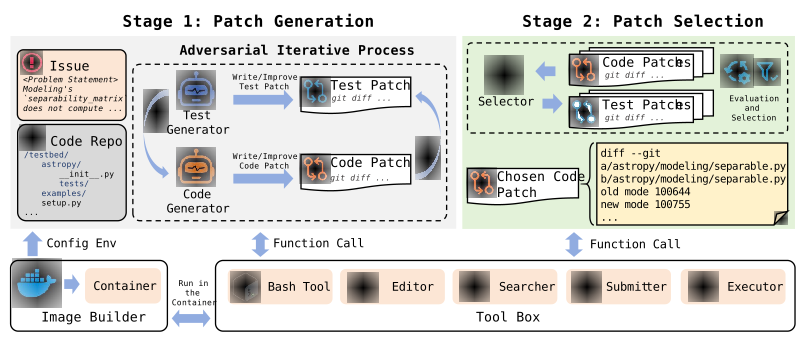
The InfCode adopts a generate-select architectural pattern. Its core modules include the **Patch Generation** and the **Patch Selection**, which are responsible for generating candidate patches and selecting the optimal patch, respectively.
- **Patch Generator**: Register multiple groups of generators, where each generator is configured with a separate container to generate and repair multiple candidate patches in parallel. Can interact with `File Editor`, `File Search`, `Bash Executor`, `Result Submitter` tools. The Patch Generator runs up to $5$ attempts and gathers all produced patches.
- The Generator internally contains two agents: a **Test Patch Generator** and a **Code Patch Generator**, that iteratively improve tests and code in an adversarial loop. The Test Generator strengthens tests to better expose faults, and the Code Generator refines patches to satisfy the newly enhanced tests.
- **Patch Selector**: Select the best patch from all the candidate patches. Can interact with `File Editor`, `File Search`, `Bash Executor` tools.
### Other Modules
In addition to the core modules, InfCode includes several other modules, such as the **Image Builder**, **Tool Executor**, and **LLM API Manager**, which handle image construction, tool execution, and API management, respectively. These modules complement the core modules and enhance the overall system functionality.
- **Image Builder**: This component is responsible for generating dedicated container images for each example in the benchmark suite. The images are stored locally and reused across iterative runs to improve efficiency.
- **Tool Executor**: This module is responsible for receiving tool-level instructions, executing the specified commands within the containerized environment, collecting the execution outputs, and transmitting the results back to the tool layer.
- **LLM API Manager**: Unified LLM API manager. It invokes the LLM API through the completion endpoint to retrieve model-generated responses. It supports integration with OpenAI, OpenRouter, and DeepSeek clients, as well as self-hosted (privately deployed) LLM instances.
## ✨ Tools Support
To enable interaction with code repositories, the InfCode is equipped with the following tools:
- **File Editor**:
- File Preview (view): Retrieve the content of a specified line range from a file within the container.
- File Creation (create): Create a new file within the container and populate it with the specified content.
- File Modification (str_replace): Modify specific portions of a given file within the container by replacing designated content.
- File Insertion (insert): Insert specified content into a designated position within a target file in the container.
- **File Searcher**:
- The LLM outputs a search pattern, which the tool uses to perform file searches within the container.
- The tool then parses and returns the results from the container.
> This module is implemented based on `ripgrep`, a high-performance file search utility that outperforms traditional `grep` in speed and supports fuzzy matching for enhanced search flexibility.
- **Bash Executor**:
- Execute Bash commands generated by the LLM within the container environment.
- Parse and return the execution results from the container.
- **Result Submitter**:
- After the LLM completes patch generation and testing, it triggers this tool and provides patch generation details.
- The tool executes `git diff` within the container to obtain and return the patch content.
## 📖 Quick Start
### 1. Environment Setup
- Create a `.env` file in the project root directory and configure the necessary environment variables:
```bash
# LLM API configuration
OPENROUTER_API_KEY=your_openrouter_api_key
```
- Install the pip dependencies, Python 3.12 is recommended.
```bash
pip install -r requirements.txt
```
### 2. Run the System
#### Batch Execution
```bash
python _batch_run.py -c config/batch.yaml --name first -i config/list_all.txt -p 2 --clean
```
Explanation:
- `-c` specifies the batch configuration file (currently minimal)
- `-name` assigns a name to this batch run
- `-i` specifies the issue list file
- `-p` sets concurrency (default 20)
- `-clean` clears the output directory before running (useful when reusing the same name)
- `-o` sets the output directory (default: ./batch_out/)
- `-h` prints help
#### Evaluation
```bash
./eval.sh
```
Explanation:
- `run_id` — required parameter identifying this evaluation run
- The script automatically reads dataset and prediction paths from `config/config.yaml`.
Since batch_run results are redirected, you may need to manually copy the preds.json file to the path specified in the config.
- Uses the official SWE-bench evaluation tool to verify generated patches
- Supports multi-process parallel evaluation (default: 20 workers)
- Results will be saved in the specified directory, including pass rates, failure reasons, and detailed logs
### 3. Configuration Files
The main configurations are in `config/config.yaml`:
- `providers`: LLM provider settings
- `runner`: runner settings (concurrency, number of iterations, etc.)
- `builder`: Docker image build settings
- `log`: logging settings
### Notes
- Ensure Docker is installed and running correctly.
- Check logs for detailed execution steps.
- Supports multiple LLM providers, tool formats are auto-selected based on configuration.
- We also provide an automated failure analysis tool based on result trace files to help you quickly identify the root cause of bad cases.[here](https://github.com/Tokfinity/InfCode/blob/main/analyzer/README.md).
## Contact
research@tokfinity.com
## Core Team
- [Pete Wong](https://petewongggg.github.io/)
- [Kirito](https://github.com/kirito41dd)
- [Hengzhi Zhang](https://henryzhang11.github.io)
- [Kefan Li](https://lbaf23.github.io)
- [Qingao Dong](https://qadong.github.io)
- [Zhichao Li](https://github.com/LanWeiFRJ)
## 📄 License
This project is licensed under the MIT License - see the [LICENSE](LICENSE) file for details.
## 🙏 Acknowledgments
We thank Anthropic for building the [anthropic-quickstart](https://github.com/anthropics/claude-quickstarts) project and bytedance for building the [trae-agent](https://github.com/bytedance/trae-agent) project that served as valuable references for the tool building.
### Core Modules
The InfCode adopts a generate-select architectural pattern. Its core modules include the **Patch Generation** and the **Patch Selection**, which are responsible for generating candidate patches and selecting the optimal patch, respectively.
- **Patch Generator**: Register multiple groups of generators, where each generator is configured with a separate container to generate and repair multiple candidate patches in parallel. Can interact with `File Editor`, `File Search`, `Bash Executor`, `Result Submitter` tools. The Patch Generator runs up to $5$ attempts and gathers all produced patches.
- The Generator internally contains two agents: a **Test Patch Generator** and a **Code Patch Generator**, that iteratively improve tests and code in an adversarial loop. The Test Generator strengthens tests to better expose faults, and the Code Generator refines patches to satisfy the newly enhanced tests.
- **Patch Selector**: Select the best patch from all the candidate patches. Can interact with `File Editor`, `File Search`, `Bash Executor` tools.
### Other Modules
In addition to the core modules, InfCode includes several other modules, such as the **Image Builder**, **Tool Executor**, and **LLM API Manager**, which handle image construction, tool execution, and API management, respectively. These modules complement the core modules and enhance the overall system functionality.
- **Image Builder**: This component is responsible for generating dedicated container images for each example in the benchmark suite. The images are stored locally and reused across iterative runs to improve efficiency.
- **Tool Executor**: This module is responsible for receiving tool-level instructions, executing the specified commands within the containerized environment, collecting the execution outputs, and transmitting the results back to the tool layer.
- **LLM API Manager**: Unified LLM API manager. It invokes the LLM API through the completion endpoint to retrieve model-generated responses. It supports integration with OpenAI, OpenRouter, and DeepSeek clients, as well as self-hosted (privately deployed) LLM instances.
## ✨ Tools Support
To enable interaction with code repositories, the InfCode is equipped with the following tools:
- **File Editor**:
- File Preview (view): Retrieve the content of a specified line range from a file within the container.
- File Creation (create): Create a new file within the container and populate it with the specified content.
- File Modification (str_replace): Modify specific portions of a given file within the container by replacing designated content.
- File Insertion (insert): Insert specified content into a designated position within a target file in the container.
- **File Searcher**:
- The LLM outputs a search pattern, which the tool uses to perform file searches within the container.
- The tool then parses and returns the results from the container.
> This module is implemented based on `ripgrep`, a high-performance file search utility that outperforms traditional `grep` in speed and supports fuzzy matching for enhanced search flexibility.
- **Bash Executor**:
- Execute Bash commands generated by the LLM within the container environment.
- Parse and return the execution results from the container.
- **Result Submitter**:
- After the LLM completes patch generation and testing, it triggers this tool and provides patch generation details.
- The tool executes `git diff` within the container to obtain and return the patch content.
## 📖 Quick Start
### 1. Environment Setup
- Create a `.env` file in the project root directory and configure the necessary environment variables:
```bash
# LLM API configuration
OPENROUTER_API_KEY=your_openrouter_api_key
```
- Install the pip dependencies, Python 3.12 is recommended.
```bash
pip install -r requirements.txt
```
### 2. Run the System
#### Batch Execution
```bash
python _batch_run.py -c config/batch.yaml --name first -i config/list_all.txt -p 2 --clean
```
Explanation:
- `-c` specifies the batch configuration file (currently minimal)
- `-name` assigns a name to this batch run
- `-i` specifies the issue list file
- `-p` sets concurrency (default 20)
- `-clean` clears the output directory before running (useful when reusing the same name)
- `-o` sets the output directory (default: ./batch_out/)
- `-h` prints help
#### Evaluation
```bash
./eval.sh
```
Explanation:
- `run_id` — required parameter identifying this evaluation run
- The script automatically reads dataset and prediction paths from `config/config.yaml`.
Since batch_run results are redirected, you may need to manually copy the preds.json file to the path specified in the config.
- Uses the official SWE-bench evaluation tool to verify generated patches
- Supports multi-process parallel evaluation (default: 20 workers)
- Results will be saved in the specified directory, including pass rates, failure reasons, and detailed logs
### 3. Configuration Files
The main configurations are in `config/config.yaml`:
- `providers`: LLM provider settings
- `runner`: runner settings (concurrency, number of iterations, etc.)
- `builder`: Docker image build settings
- `log`: logging settings
### Notes
- Ensure Docker is installed and running correctly.
- Check logs for detailed execution steps.
- Supports multiple LLM providers, tool formats are auto-selected based on configuration.
- We also provide an automated failure analysis tool based on result trace files to help you quickly identify the root cause of bad cases.[here](https://github.com/Tokfinity/InfCode/blob/main/analyzer/README.md).
## Contact
research@tokfinity.com
## Core Team
- [Pete Wong](https://petewongggg.github.io/)
- [Kirito](https://github.com/kirito41dd)
- [Hengzhi Zhang](https://henryzhang11.github.io)
- [Kefan Li](https://lbaf23.github.io)
- [Qingao Dong](https://qadong.github.io)
- [Zhichao Li](https://github.com/LanWeiFRJ)
## 📄 License
This project is licensed under the MIT License - see the [LICENSE](LICENSE) file for details.
## 🙏 Acknowledgments
We thank Anthropic for building the [anthropic-quickstart](https://github.com/anthropics/claude-quickstarts) project and bytedance for building the [trae-agent](https://github.com/bytedance/trae-agent) project that served as valuable references for the tool building.