
Discovering, detecting, and surgically removing Google's AI watermark through spectral analysis






Left: SynthID watermark extracted from a pure-black Gemini image (enhanced 100×). Right: Same watermark on a white background. The diagonal stripe pattern and carrier frequencies are clearly visible.
### Carrier Frequency Discovery The watermark embeds energy at specific carrier frequencies with **>99.9% phase coherence** across all images: | Carrier Frequency (fy, fx) | Phase Coherence | Magnitude | Phase (rad) | |:--------------------------:|:---------------:|:---------:|:-----------:| | **(±14, ±14)** | 99.96% | 16,807 | ±1.44 | | **(±126, ±14)** | 99.96% | 8,046 | ±2.37 | | **(±98, ∓14)** | 99.94% | 6,283 | ±0.61 | | **(±128, ±128)** | 99.25% | 6,908 | ±2.29 | | **(±210, ∓14)** | 99.96% | 6,032 | ±1.13 | | **(±238, ±14)** | 99.90% | 4,190 | ±1.61 | > **Key insight:** Most carriers cluster along the `y = ±14` line in frequency space, suggesting a structured frequency selection algorithm. The diagonal stripe pattern visible in the enhanced images corresponds to these carrier frequencies. ### Phase Consistency - A Fixed Model-Level Key The watermark's phase template is **identical across all images** from the same Gemini model: - **Green channel phase std**: < 0.007 radians across 50 reference images - **Cross-image correlation**: 21.8% mean pairwise noise correlation - **Noise structure ratio**: 1.32 ± 0.02 (byproduct of the neural encoder) This means SynthID does not embed per-image messages - it uses a **fixed spectral fingerprint** that can be profiled and subtracted. ### Frequency Spectrum Analysis


Left: FFT magnitude spectrum showing bright carrier frequency peaks. Right: Reconstructed carrier pattern showing the diagonal structure.
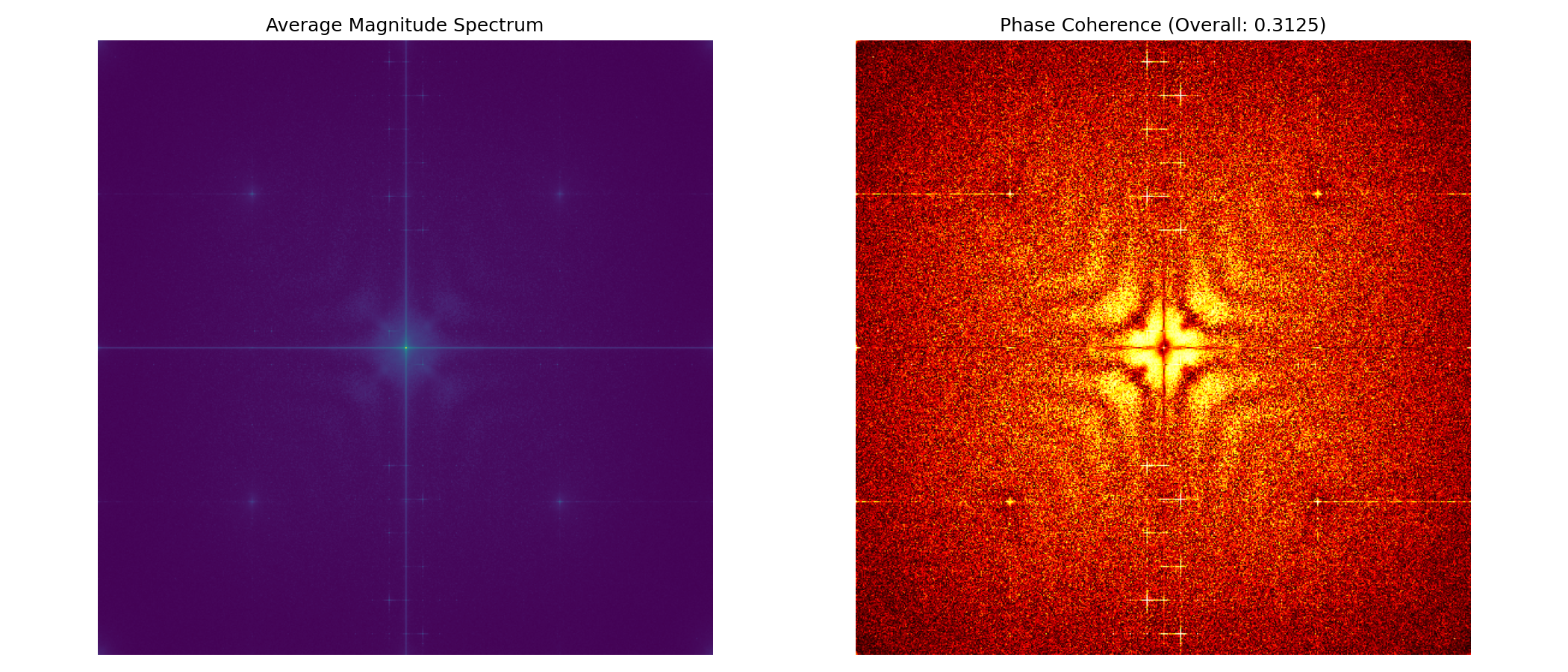
Detailed frequency analysis: Average magnitude spectrum (left) and phase coherence map (right). The carrier positions are marked with crosshairs.
--- ## 🏗️ Architecture ### Three Generations of Bypass | Version | Approach | PSNR | Detection Impact | Status | |:-------:|:---------|:----:|:----------------:|:------:| | **V1** | JPEG compression (Q50) | 37 dB | ~11% phase drop | ✅ Baseline | | **V2** | Multi-stage transforms (noise, color, frequency) | 27-37 dB | ~0% confidence drop | ✅ Quality trade-off | | **V3** | Spectral codebook subtraction | **33-43 dB** | **1-7% confidence drop** | ✅ Best quality | ### V3 Pipeline (Spectral Bypass) ``` Input Image → FFT per channel → Estimate Watermark → Subtract → IFFT → Clip → Output ↑ SpectralCodebook (25 black + 25 white refs) ``` 1. **SpectralCodebook** profiles the watermark from reference images (pure black/white Gemini outputs) 2. **Selective notch filter** targets only high-magnitude (P97+), high-consistency (≥95%) frequency bins 3. **Safe magnitude cap** limits subtraction to 30% of image energy per bin - preserving content 4. **Content-adaptive scaling** adjusts subtraction based on image luminance --- ## 📊 Results ### V3 Bypass Quality (PSNR in dB - higher is better) | Image | Gentle | Moderate | Aggressive | Maximum | |:-----:|:------:|:--------:|:----------:|:-------:| | 121407 | **42.9** | 41.4 | 40.0 | 39.3 | | 110802 | 33.4 | 33.3 | 33.1 | 33.0 | | 131614 | **38.4** | 38.0 | 37.5 | 37.2 | | 119198 | **38.4** | 37.7 | 37.0 | 36.6 | | 12085 | **42.5** | 41.6 | 40.7 | 40.3 | > All images maintain **>33 dB PSNR** - visually indistinguishable from the original. ### Watermark Detection Confidence | Image | Before | After (Aggressive) | Drop | |:-----:|:------:|:------------------:|:----:| | 121407 | 0.394 | 0.387 | 1.7% | | 131614 | 0.437 | 0.422 | 3.4% | | 12085 | 0.394 | 0.366 | **7.2%** | | 119198 | 0.389 | 0.386 | 0.9% | ### Sample Output


Left: Original SynthID-watermarked Gemini image. Right: After V3 spectral bypass - visually identical, watermark energy reduced.
--- ## 🚀 Quick Start ### Installation ```bash git clone https://github.com/aloshdenny/reverse-SynthID.git cd reverse-SynthID python -m venv venv source venv/bin/activate # Windows: venv\Scripts\activate pip install -r requirements.txt ``` ### 1. Build Detection Codebook ```bash python src/extraction/robust_extractor.py extract /path/to/watermarked/images \ --output artifacts/codebook/robust_codebook.pkl ``` ### 2. Detect Watermark ```bash python src/extraction/robust_extractor.py detect image.png \ --codebook artifacts/codebook/robust_codebook.pkl ``` ``` Detection Results: Watermarked: True Confidence: 0.95 Phase Match: 0.6683 ``` ### 3. Build Spectral Codebook (V3) ```python from synthid_bypass import SpectralCodebook codebook = SpectralCodebook() codebook.extract_from_references( black_dir='assets/black/', # Pure-black Gemini images white_dir='assets/white/' # Pure-white Gemini images ) codebook.save('artifacts/spectral_codebook.npz') ``` ### 4. Run V3 Bypass ```python from synthid_bypass import SynthIDBypass, SpectralCodebook codebook = SpectralCodebook() codebook.load('artifacts/spectral_codebook.npz') bypass = SynthIDBypass() result = bypass.bypass_v3(image_rgb, codebook, strength='aggressive') print(f"PSNR: {result.psnr:.1f} dB") # ~40 dB ``` **Strength levels:** `gentle` (minimal change, ~43 dB) → `moderate` → `aggressive` → `maximum` (strongest removal, ~33 dB) --- ## 📁 Project Structure ``` reverse-SynthID/ ├── src/ │ ├── extraction/ │ │ ├── synthid_bypass.py # V1/V2/V3 bypass implementations + SpectralCodebook │ │ ├── robust_extractor.py # Multi-scale watermark detection (90% accuracy) │ │ ├── watermark_remover.py # Frequency-domain watermark removal │ │ ├── benchmark_extraction.py # Performance benchmarking suite │ │ └── synthid_codebook_extractor.py # Original codebook extractor (legacy) │ └── analysis/ │ ├── deep_synthid_analysis.py # FFT/phase analysis scripts │ └── synthid_codebook_finder.py # Carrier frequency discovery │ ├── assets/ │ ├── synthid_black.jpg # Watermark on black (enhanced) │ ├── synthid_white.jpg # Watermark on white (enhanced) │ ├── black/ # Reference black images from Gemini │ └── white/ # Reference white images from Gemini │ ├── artifacts/ │ ├── codebook/ # Detection codebooks (.pkl) │ ├── spectral_codebook.npz # V3 spectral fingerprint (119 MB) │ ├── v3_output/ # V3 bypass output samples │ └── visualizations/ # FFT, phase, carrier visualizations │ ├── watermark_investigation/ # Early-stage Nano-150k analysis (archived) ├── SYNTHID_CODEBOOK_ANALYSIS.md # Detailed codebook reverse-engineering report ├── synthid.pdf # SynthID paper reference └── requirements.txt ``` --- ## 🔬 Technical Deep Dive ### How SynthID Works (Reverse-Engineered) ``` ┌──────────────────────────────────────────────────────────────┐ │ SynthID Encoder (in Gemini) │ ├──────────────────────────────────────────────────────────────┤ │ 1. Generate carrier frequencies: {(14,14), (126,14), ...} │ │ 2. Assign fixed phase values to each carrier │ │ 3. Neural encoder adds learned noise pattern to image │ │ 4. Watermark is imperceptible - spread across spectrum │ ├──────────────────────────────────────────────────────────────┤ │ SynthID Decoder (in Google) │ ├──────────────────────────────────────────────────────────────┤ │ 1. Extract noise residual (wavelet denoising) │ │ 2. FFT → check phase at known carrier frequencies │ │ 3. If phases match expected values → Watermarked │ └──────────────────────────────────────────────────────────────┘ ``` ### SpectralCodebook Extraction The codebook captures the watermark's full frequency fingerprint: - **50 reference images** (25 pure black + 25 pure white, all from Gemini) - Extracts **magnitude envelope** and **phase template** per channel - Computes **phase consistency score** per frequency bin - Content-adaptive profiles for dark vs. light image regions ### Selective Notch Filter The V3 bypass doesn't subtract blindly - it targets only bins where: 1. **Magnitude** exceeds the 97th percentile (strong watermark energy) 2. **Phase consistency** ≥ 0.95 across reference images (confirmed watermark, not noise) 3. **Subtraction** is capped at 30% of the image's energy at each bin This surgical precision is why V3 achieves 40+ dB PSNR while still reducing watermark energy. ### Noise Correlation Signature | Metric | Value | Significance | |:-------|:-----:|:-------------| | Mean pairwise noise correlation | **0.218** | Identical watermark in all images | | Noise structure ratio | **1.32** | Neural encoder byproduct | | Phase coherence (top carriers) | **>99.9%** | Fixed model-level key | | Green channel phase std | **<0.007 rad** | Strongest consistency channel | ### Bit Plane Analysis | Bit Plane | Consistency | Role | |:---------:|:-----------:|:-----| | Bit 0 (LSB) | 0.049 | Watermark signal | | Bit 1 | 0.074 | Watermark signal | | Bit 2 | 0.125 | Partially watermarked | | Bit 3 | 0.513 | Mixed | | Bits 4-7 | 0.635–1.000 | Image structure | --- ## 🛠️ Core Modules ### `robust_extractor.py` - Detection Multi-scale, multi-denoiser watermark detector achieving 90% detection rate. ```python from robust_extractor import RobustSynthIDExtractor extractor = RobustSynthIDExtractor() extractor.load_codebook('artifacts/codebook/robust_codebook.pkl') result = extractor.detect_array(image) print(f"Watermarked: {result.is_watermarked}") print(f"Confidence: {result.confidence:.4f}") print(f"Phase Match: {result.phase_match:.4f}") ``` **Features:** - Multi-scale analysis (256, 512, 1024px) - Wavelet + bilateral + NLM denoising fusion - ICA-based watermark/content separation - Ensemble carrier detection across scales ### `synthid_bypass.py` - Bypass (V1/V2/V3) Three generations of watermark bypass: ```python from synthid_bypass import SynthIDBypass, SpectralCodebook bypass = SynthIDBypass() # V1: Simple JPEG compression result = bypass.bypass_simple(image, jpeg_quality=50) # V2: Multi-stage transform pipeline result = bypass.bypass_v2(image, strength='moderate') # V3: Spectral codebook subtraction (best) codebook = SpectralCodebook() codebook.load('artifacts/spectral_codebook.npz') result = bypass.bypass_v3(image, codebook, strength='aggressive') ``` ### `watermark_remover.py` - Removal Quality-preserving frequency-domain removal: ```python from watermark_remover import WatermarkRemover remover = WatermarkRemover(extractor) result = remover.remove(image, mode='balanced') ``` --- ## 📚 References - [SynthID: Identifying AI-generated images](https://deepmind.google/technologies/synthid/) - [SynthID Paper (arXiv:2510.09263)](https://arxiv.org/abs/2510.09263) --- ## ⚠️ Disclaimer This project is for **research and educational purposes only**. SynthID is proprietary technology owned by Google DeepMind. These tools are intended for: - 🎓 Academic research on watermarking robustness - 🔒 Security analysis of AI-generated content identification - 📡 Understanding spread-spectrum encoding methods **Do not use these tools to misrepresent AI-generated content as human-created.**