mirror of
https://github.com/AnLoMinus/Diablo.git
synced 2026-10-04 06:57:05 +02:00

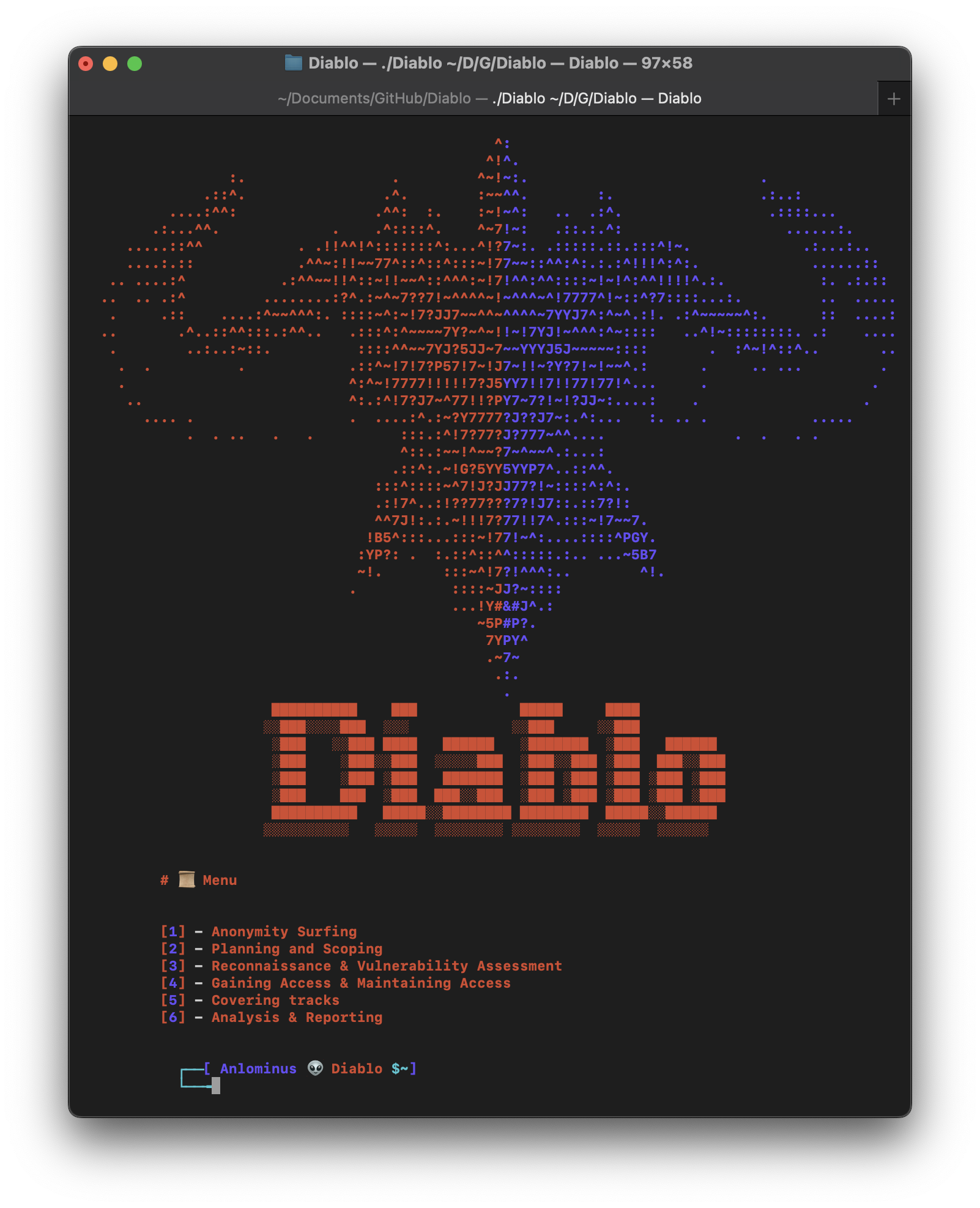
📜 Menu / To Do
- [a] - Anonymity Surfing
- [1] - Planning and Scoping
- [2] - Reconnaissance & Vulnerability Assessment
- [3] - Gaining Access & Maintaining Access
- [4] - Covering tracks
- [5] - Analysis & Reporting
┌──[ Anlominus 👽 Diablo $~]
└──╼
1) Steps Example
Reconnaissance
- The observation stage:
- attackers typically assess the situation from the outside-in, in order to identify both targets and tactics for the attack.
Intrusion
- Based on what the attackers discovered in the reconnaissance phase, they’re able to get into your systems:
- often leveraging malware or security vulnerabilities.
Exploitation
- The act of exploiting vulnerabilities, and delivering malicious code onto the system, in order to get a better foothold.
Privilege Escalation
- Attackers often need more privileges on a system to get access to more data and permissions:
- for this, they need to escalate their privileges often to an Admin.
Lateral Movement
- Once they’re in the system, attackers can move laterally to other systems and accounts in order to gain more leverage:
- whether that’s higher permissions, more data, or greater access to systems.
Obfuscation / Anti-forensics
- In order to successfully pull off a cyberattack, attackers need to cover their tracks, and in this stage they often lay false trails, compromise data, and clear logs to confuse and/or slow down any forensics team.
Denial of Service
- Disruption of normal access for users and systems, in order to stop the attack from being monitored, tracked, or blocked
Exfiltration
- The extraction stage:
- getting data out of the compromised system.
Sources
- Inspirational tools
-
as Anonymity Surfing
-
pl Planning
-
sv Scanning Vulnerability
-
ga Gaining Access
-
ma Maintaining Access
-
ct Covering tracks
-
an Analysis
-
rp Reporting
-
Tools:
-
Cheat Sheets:
-